I was chatting with a friend and showing them pictures of my shield progress, and they asked some questions that led me to the realization that many of you aren't aware of what repoussé is. So for this post, I'm actually going to go more high-level (no project update folks, sorry) and explain in more detail what repoussé is.
Repoussé (pronounced Reh-Pew-Zay) literally translated, is the art of "raising", specifically in metal. Simply put, it's the art of creating a 3-dimensional art surface from a sheet of metal. The technique is thousands of years old and was heavily used by blacksmiths, armorers, jewelers, and others. Many of today's techniques for tooling leather are also similar. The same general principles apply to tool leather as well as to emboss metal. Repoussé is sometimes done without "chasing" but usually both are used in conjuction with one another to create an embossed design.
Repoussé is to work the back of the piece, so that from the front you have a raised design. Chasing is fundamentally the same, but instead you are working the front to create detail or depressions on the front surface.
The process generally works as follows: You have a sheet of metal, and by taking very smoothed punches and chisels (the tips are highly polished so as not to "cut" the metal, but instead to "push" it). You use a liner (small chisel like shape) to line the detail of your work. To absorb the shock of the process, the work piece is placed on a firm, but giving surface. Loosely referred to as a "chasing medium" or "chaser's pitch". Chaser's pitch is a substance made from tar, pitch, clay, sand, etc to create a firm yet viscous surface to strike against. For heavier work such as steel, lead or tin is generally used as a chasing medium. Here are some examples of repousse and chased work:
Taking a hammer and these smoothly polished punches/chisels you work the metal into the chasing medium, slowly raising the design from the sheet. The chasing medium serves two purposes simultaneously. First, it provides a firm surface to help support the non-raised areas and ensure the entire shock of the blow is focused on the area you are moving. Second, the chasing medium is soft enough to give directly beneath the struck area so the design is raised and you don't just bang it against another hard surface, thinning the work metal too much. This is one key area where chasing and repoussé differ from blacksmithing.
You want to continually anneal the work piece if it is made from a metal that will work harden. Many metals get more brittle as the molecules are compacted. Have you ever taken metal wire and bent it, then bent the same spot the other way, then again and again? Eventually it snaps. This is due to the "work hardening" that is happening at the bend point on the metal. Annealing loosens the molecules again and keeps the metal malleable and prevents it from becoming brittle and cracking while you're working. Materials like copper, brass and bronze work harden very quickly and so you must anneal quite often. Steel work hardens more slowly, but in general is harder to move due to its strength.
Once you've raised the surface, you flip the worked piece over and do the same thing from the front, making the lines sharper, or recessing areas that have unintentionally become raised (generally around the edges of the design you are trying to emboss).
That's repoussé in a nutshell, but words can never do as well as a short video. Here is a repoussé artist creating repousse onto a plate of sterling silver. You can see the general process in this short (roughly 7-minute) video. This is precisely the process I am using for my shield (and will be using for the armor for the Zelda costume). For the shield, the major differences are in the size and weight of the chisels I am using, the hammers I am using are heavier, and the chasing medium is not pitch (as in the video), but instead I am using pure tin (which is soft similar to lead, but less hazardous).
Take a look, this will help y'all understand what it is exactly that I'm doing to produce the embossed loftwing on the shield:
Davide Bigazzi Performing Repoussé to Make a Decorative Silver Plate
We also have Victoria Lansford, who has written many books on the subject:
Another great video by Victoria Lansford on using the art of Eastern Repoussé
One interesting final note, I am willing to bet you've seen a famous repoussé piece of artwork and haven't even realized it. One of the most famous works done using repoussé is none other than the Statue of Liberty in New York, USA. That was done using repoussé on VERY MASSIVE copper sheet/plate. It's the same technique only at a sculptural and architectural scale. VERY impressive.
It's a fun craft to learn. The work is very effort intensive and as such, pieces made using this technique are VERY expensive. They are beautiful though!
Now back to our regularly scheduled program of my project! Thanks, everyone!
An all-out, no expense spared cosplay of Link and Zelda from the Twilight Princess installment of the series. Follow the journey as it goes from idea to final completion. This will be a cosplay for the ages! If you ever wanted to depart from the resin and fiberglass cosplays and step into what a true and plausible Link cosplay would look like, then check this blog out!
Friday, April 18, 2014
Sunday, April 13, 2014
A loftwing begins to emerge...
Hey everyone,
So yesterday I had the pleasure of visiting a friend's house. He also happens to be a blacksmith. I got some great pointers on working with steel (as opposed to the non-ferrous metals to which I am more accustomed). In so doing, I managed to make some good progress on the shield embossing. The MAP gas torch, by the way, makes a HUGE difference.
So let's walk through where we are:
You can see from the white cloudiness that with the new torch, I was able to get the steel MUCH hotter (and consequently much more malleable). This then let me make some actual movement on lining the loftwing in:
The lines are a bit rough. You can see, if you look closely, it's more like a nearly-connected set of "dashes" made with the moving chisel.
Given the shield is so thick, this actually still produces a decent form on the front side. I will still make them smoother as I go as well as when I get to the full raising
stage of the process.
Now as you look at the front you'll notice the lines are not crisp. That is okay as the "chasing" part of the process is where those lines from the front will get more crisp. Here is what we have when looking at the front:
And from further out you can start to make out a loftwing on the front of the shield:
It's exciting to see the pattern start to emerge. I still have a long ways to go, but very reassuring progress!
Monday, April 7, 2014
I'm all for by-hand but...
Hey everyone, so I made some recent progress (and had a bit of a setback, too) on the shield. We'll start with the bad news.
First, repousse on steel is HARD!!! I've now done some on non-ferrous metals (copper, brass, etc.) and, while it work hardens, it is relatively malleable to emboss. Steel work hardens much less than those metals and even can sometimes be cold-hammered. So, out come the three-pound sledge and the repousse tools and I am thinking I can make some progress on the loftwing pattern. NOPE!!! Won't budge. So then I think: let's add some heat! NOPE! All I managed to do was scorch it. So clearly I need a hotter flame and I am probably gonna have to get it to almost forging temperature, but we'll come back to that...
Bad news (but some good news, too): I got started on my triangle edge-beveling! Here we have something to show for it:
Nice and clean, huh? Well. That one edge took FOUR AND A HALF HOURS!!! I'm all for by-hand, but at 4.5hrs per edge... That means we're looking at 40.5 hours just to rough-bevel the triangles! That doesn't even include the polishing! Yikes! So... I need something to speed things along at least for the majority of the stock removal. So this morning I ordered a belt grinder. Hehe. C'mon, I know, I know. I can hear you saying it. "Smiths of old never had belt grinders!" Well... If they did they'd have used them, People. Cut me some slack. I want to work smart. I will still be doing the finishing work (final filing and polishing) by hand. I just want help with the general shaping!
In other news, and something that went exactly as planned, was the bending of the triangles to match the curvature of the shield. I just threw each triangle on my Arbor press and gave the handle a good pull (not TOO much) and voila!
You can see they now have a gentle curve that matches the curve of the shield. I love my Arbor press!
So, now having ordered the belt grinder, I also decided I needed a hotter torch, so I also ordered: a MAPP gas torch and threw in some more of the raw materials I will need to finish up the fabrication of the shield: 1/8" diameter steel rod (to frame the triforce), and 1/8" thickness steel plate (to make the thorns, and the accents pieces of the edging/rim).
I just need to get the actual sheet for the basic rim and I will have procured all the metals necessary for the shield. Once fabrication is done I can then worry about finishing (acid etching, enameling and mounting).
Coming along!
Sunday, March 30, 2014
Some planning and stenciling
Well, so today is a layout day! I have the rough cut triangles and the loftwing stenciled, so now to start putting it together and planning out the rim and thorn-work on the face. I will need to know general shape and size to fit this particular shield so it all fits together well. I began by planning out the accents in the rim which are basically pentagons of various proportions. I will have a 1" band around the perimeter of the face and when you combine that with placement of the triangle and the loftwing it starts to show how the thornwork will fit in. This is good because now I have the dimensions of those pieces and can do more cutting!
Only needing one side as I will mirror the pieces for the other side. Here is where we are:
You can start to see how the design will shape up on the face of the shield. The thorns are rough sketch with the accents being more precisely lined. I'll clean up the thorns and use a French curve set to ensure the curves are aesthetically pleasing.
The pentagons will be made from either 1/8" or 3/16" mild steel plate (I haven't decided which yet). The banding itself will be 16ga sheet. The thorns will be 3/16" mild steel but will be hollow ground as in the design such that it will have a spine that flows with the lines.
You can see also where I will be hiding the bolts for the grip straps to hide the unsightly mounts. The bottom part of the straps will be built into two of the accent pentagons and the top ones will be built into the larger thorns.
On the reverse side, I have the loftwing (bird) lined in and ready to emboss into the steel.
Not too shabby, I say!
Until next time!
Saturday, March 29, 2014
Some interesting press...
Hey all! I noticed since designing the greatest of Master Swords and having Brendan bring my concept to reality, it's gotten some notice!
Here are some articles (the KoH one grabbed some quotes from me to write) that spotlight the most combat ready Master Sword to exist to date:
Knights of Hyrule (http://www.knightsofhyrule.org/2013/10/realistic-master-sword-keeps-knights-line-true/)
Kotaku (http://kotaku.com/do-you-have-a-real-master-sword-this-guy-does-1451138869/all)
RipItUp (http://www.ripitup.co.nz/gaming/youre-probably-not-as-big-a-zelda-fan-as-this-guy/)
It's cool to see the sword get some notice. I cannot express how well balanced and beautiful it is! It slices through bamboo and rolled newspaper, foam and other common cutting targets like a hot knife through butter!
When at rest, it has a treasured place on my wall:
Friday, March 28, 2014
A triforce has been minted
Hi all! Well I have the brass cut for the triforce on the face of the shield! Taking a total of 5 hours of cutting with an extremely fine kerf diamond carbide blade saw, the three triangles are rough cut. They now need to be slightly bent to match the curvature of the shield, beveled and polished. I then will form the framing from 1/8" diameter iron. And then I can begin embossing the Loftwing (the Phoenix looking bird on the face) into the steel. I have laid the triangles on the face to give you all an idea...
It's coming slowly, but good things are worth the wait!
Saturday, March 8, 2014
Down to brass tacks
Wow, it has been a while since I posted! Loving the sword, and at this point the costume for Link itself is done except the distressing (I will cover that when I get to it). Today let's talk about the shield. It is going slow, but I do have the basic 16ga. steel blank which will serve as my foundation of the shield prepped and ready. Good heater shield shape.
I also have gotten as far as the triforce stencil made and the first set of triangles cut from the 3/16" brass plate. Do you have ANY idea how hard it is to cut 3/16" thick 260 machine brass by hand? Wow.
So it'll be a short update today but progress is being made! Once the triangles are all cut I will begin the beveling and polishing process...
Thursday, October 10, 2013
The Hero's Triumph on Cataclysm's Eve, wins three Symbols of Virtue. The Master Sword he will then retrieve, keeping the Knights' line true.
Well, folks, Brendan has finished his masterpiece and will be shipping
the sword soon. I have included a number of final photos that he sent
along for final commission approval in varying light (the first set is
in twilight and the second set being in more brilliant daylight. You
can see how the colors are set off by different light schemes which I
really like.)
First we have a couple pictures from the twilight set:
And then we have a couple from the daylight set:
Brendan also provided a post for it on the Fable Blades Facebook page. It is located here.
I am super happy with how it turned out! I should be receiving it physically in a couple of weeks, as he is now getting it prepped for shipping and it will be on its way to me soon! I can't wait!
First we have a couple pictures from the twilight set:
And then we have a couple from the daylight set:
- We also have some final specs on the sword as follows:
- Material: 9260 Spring Steel, Bronze
- Overall grip length from the pommel ring to the top of the diamond on the guard is 207mm (8.15”)
- Overall blade length is 811mm (31.93”)
- Overall Length is 1052mm (41.41”)
- Weight is 1490g (3.284 lbs.)
- Blade Width:
- Waist 35mm (1.377")
- Flare 52mm (2.047")
- End of Fuller 31mm (1.22")
- Point of balance is about 83mm (3.26”) from the blade shoulder where it sits in the guard.
- Center of Percussion: 515mm (20.2”) from that same point.
- Hilt node of percussion: is 52mm (2.05”) back from top of the diamond in the guard. Its a fraction forward of the center of the fore grip.
Brendan also provided a post for it on the Fable Blades Facebook page. It is located here.
I am super happy with how it turned out! I should be receiving it physically in a couple of weeks, as he is now getting it prepped for shipping and it will be on its way to me soon! I can't wait!
Sunday, October 6, 2013
Double, double, toil and trouble, fire burn and cauldron bubble... Making mushroom brew, I am...
Hello everyone! I thought I would drop a post today because I had a great find! Last evening my wife and I were at her parents' house. Sitting on their window sill was a thing of beauty! Clearly I am a nerd, because seeing these bottles made me think perfection for Zelda potions (and fairies or Lon Lon milk).
Upon asking them where they got them, expecting to hear a craft store of some note, I was surprised to hear they were Spanish Saffron bottles from Trader Joe's!!!
Now I am equipped with 3 bottles for a blue potion, a red potion and a fairy! (I will cover the production of these in a later post); I may get a fourth to do Lon Lon milk as well. :)
Until next time!
Saturday, October 5, 2013
Sword is almost done!
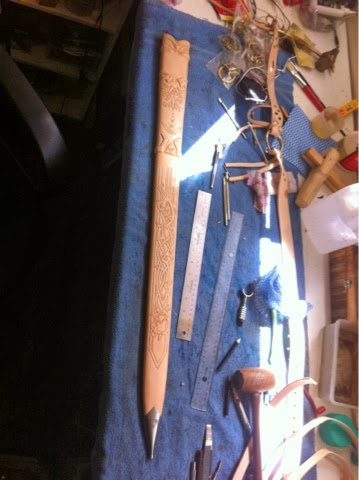
So this will probably be the second-to-last post on the sword. The next post will likely be the final and finished product. Brendan has a few minor things on the sword itself (namely the inscription work on the pommel), but he has been diligently working on the scabbard now. Here we have some tooling on the scabbard. This is the raw and un-dyed scabbard and the tooling for the suspension straps on the scabbard belt:
Once fully tooled, he will be dying it blue with a tinge of crimson such that it is the Twilight Princess "purplish-blue". The accents and raised areas will be gold.
He is nearly done!
Friday, September 27, 2013
The beginnings of a scabbard
Well, now Brendan is on to starting the scabbard... He has the chape and scabbard core done. Thought I would share with you all!
I thought the triforce on the chape is a nice touch!
In other news, I have the template for the crown made up and will be ordering the sheet bronze soon. I am debating between 14 gauge or 16 gauge. I suspect I will wind up with 14 gauge but may have a harder time shaping it.
I may go with 16 gauge for the crown and belt, and 14 for the pauldrons and amulet.
Decisions, decisions!
Subscribe to:
Posts (Atom)